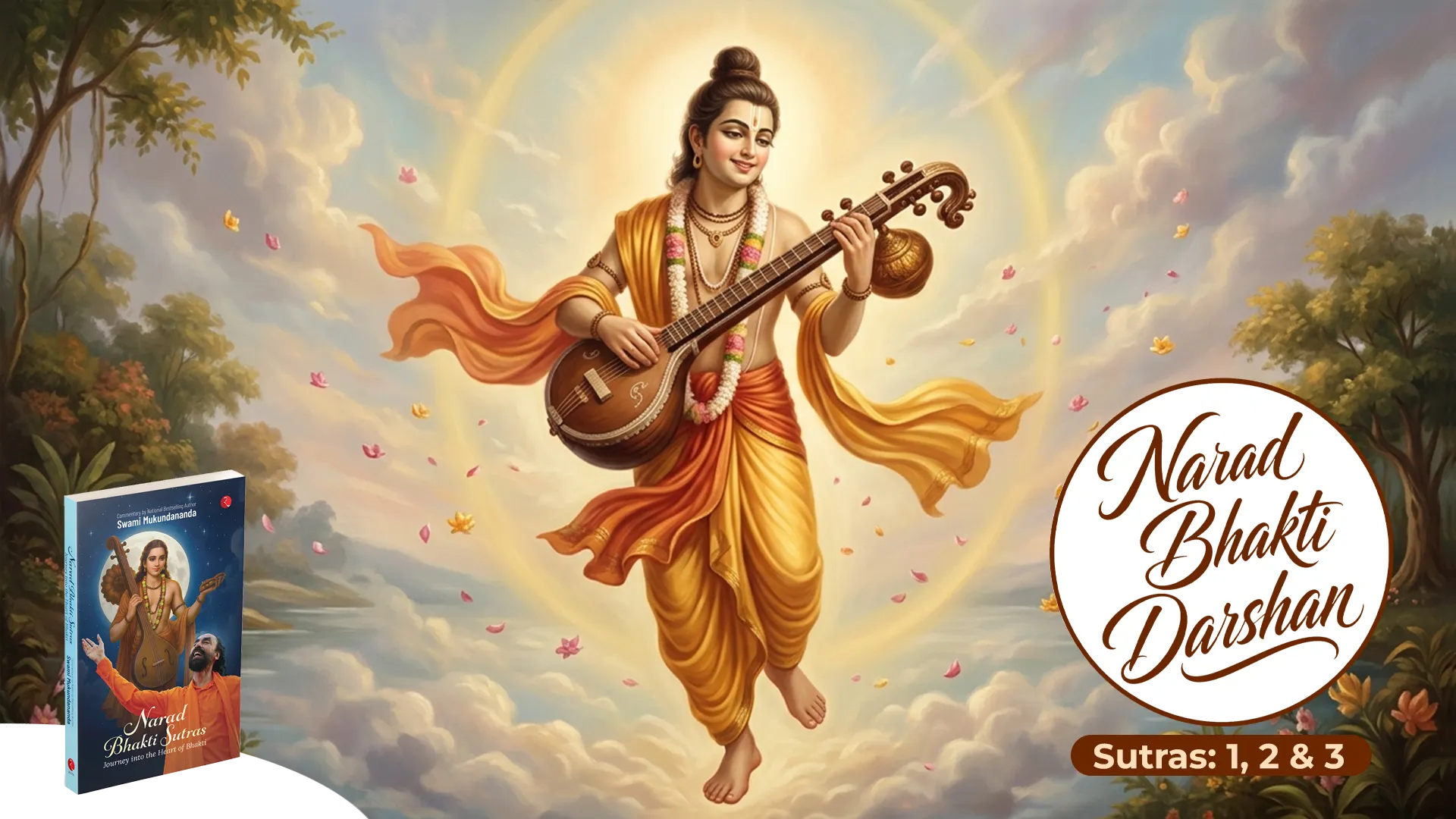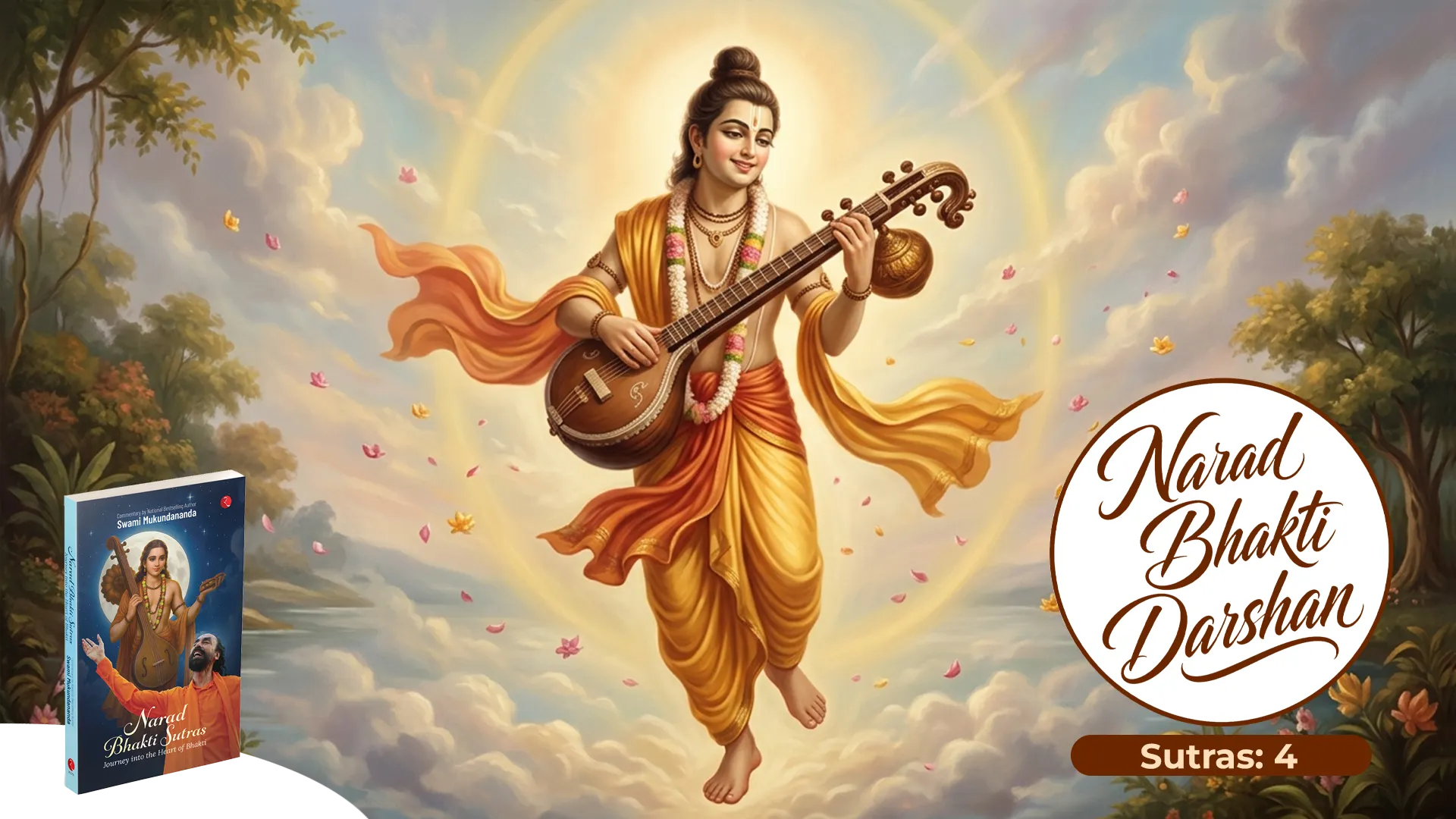
Every soul longs for three things: perfection, freedom, and lasting fulfilment. Yet despite endless pursuits in the world, these remain incomplete. Human beings naturally ask: What will I truly gain in life? What can finally remove inner emptiness and restlessness? The sages explain that these deepest longings are fulfilled not through worldly achievement, but through Bhakti, divine love for God.
The path of Bhakti does not merely offer comfort or temporary happiness. It transforms the heart, liberates the soul, and brings a satisfaction that nothing material can provide. The saints describe this divine love as the highest attainment, because through it a person becomes inwardly perfected, freed from fear and bondage, and fully fulfilled from within.
Narad Bhakti Sutra Four: Fruits of Divine Love
Sutra 4 of the Narad Bhakti Sutra says:
लब्ध्वा पुमान् सिद्धो भवत्यमृतो भवति तृप्तो भवति
Yallabhdvā pumān siddho bhavati, amṛito bhavati, tṛipto bhavati
Translation: By attaining Bhakti, a person becomes perfected, immortal, and fully satisfied.
With this sutra, Narad begins to describe the results of Bhakti. One might say—lovingly—that the Acharya is now “marketing” Bhakti. Why? Because human beings naturally ask: What do I gain? What happens to me if I follow this path?
Naradji answers that question directly. He explains that the one who truly receives Bhakti gains three things:
- Siddhi (Perfection)
- Amritatva (Freedom from birth and death)
- Trupti (Complete satisfaction)
Let us look at each of these, not superficially, but in the deeper sense intended by the Acharyas.
Siddho Bhavati: Bhakti Makes One Perfect
Naradji first says: “Siddho bhavati” — the devotee becomes Siddha.
At first glance, this word can be misleading. In yogic traditions, siddhis refer to mystic powers acquired through intense yogic practice, such as becoming extremely light or heavy, reading minds, or manifesting objects. These powers arise from the concentration of the mind through Ashtanga Yoga.
However, these siddhis are material, not divine. Anyone who practices advanced yoga may attain them. That alone does not make someone God-realized.
The great saints make this very clear. The Bhagavatam states that a devotee who has love at the lotus feet of God has no interest in mystic powers, heavenly positions, or even liberation. Why? Because divine love makes everything else insignificant.
There is a beautiful story where Ram offers Kagbhushundi boons such as wealth, powers, or liberation. Kagbhushundi replies, “I want only that divine love which great yogis and sages search for, and which one soul among millions receives by Your grace.”
So when Naradji says Siddha, he does not mean mystic powers.
What does he mean?
He means inner perfection.
Just as saints say, “Cook the rice until it becomes soft,” Bhakti softens the heart. It melts away impurities, ego, and hardness. The heart begins to naturally flow toward God. This is true, Siddhi—a heart perfected in love.
Amrito Bhavati: Bhakti Makes One Immortal
Next, Naradji says: “Amrito bhavati” — the devotee becomes immortal.
This means freedom from the endless cycle of birth and death.
Interestingly, the devotee does not desire liberation (mukti). Desire itself—even for liberation—is a form of selfishness, and love cannot coexist with selfishness.
The bhakta says:
“I don’t want the world.
I don’t want liberation.
I only want the happiness of my Beloved.”
I don’t want liberation.
I only want the happiness of my Beloved.”
There is a famous dialogue where Mukti herself comes to the door of a devotee. The devotee says:
“Please go away. Even your fragrance will make my love selfish.”
Mukti replies, “Krishna Himself has sent me.”
The devotee answers, “Then go and serve Him. I am not interested.”
The devotee answers, “Then go and serve Him. I am not interested.”
Yet God’s law is this: when Bhakti is perfected, liberation becomes automatic. The devotee may be willing to take birth again and again, but God will not allow it. Divine love frees the soul without asking.
A Sufi saint beautifully expressed this:
“Daulat mili hai ishq ki, ab aur kya mile?
Woh cheez mil gayi hai jisse Khuda mile.”
Woh cheez mil gayi hai jisse Khuda mile.”
I have gained the wealth of love—what more is left to gain?
I have found that through which God Himself is found.
I have found that through which God Himself is found.
Saints explain it simply: run after God, and liberation will follow you like a servant.
Tripto Bhavati: Bhakti Brings Complete Satisfaction
Finally, Naradji says: “Tripto bhavati” — the devotee becomes fully satisfied.
This satisfaction is what every soul has been searching for across countless lifetimes.
We search through relationships, achievements, possessions—again and again—yet satisfaction never lasts. The reason is simple: we have forgotten our original, perfect relationship with God.
God is our perfect:
- Beloved
- Friend
- Parent
- Child
- Master
The inner dissatisfaction we feel is not a flaw—it is God’s signal:
“You are looking in the wrong place. Come back to Me.”
When that relationship is restored through Bhakti, the soul finally rests.
The Unique Joy of Bhakti
Knowledge (Gyan) brings satisfaction. Yoga (Yog) brings satisfaction.
But Bhakti is different.
In Gyan, satisfaction is static. In Bhakti, satisfaction is dynamic.
The devotee experiences fullness, and then a deeper hunger arises. He serves again, loves again, and becomes even more fulfilled.
It is like rivers flowing endlessly into the ocean—the ocean keeps receiving, yet never overflows.
A poet says:
“Prem mein purnima nahi.”
In divine love, there is no full moon followed by decline; there is only continuous waxing.
Bhakti never diminishes. It only grows.
Conclusion
Naradji’s message is clear and compassionate:
- Bhakti perfects the heart
- Bhakti frees the soul
- Bhakti fulfils the deepest longing of existence
This is not theoretical philosophy; it is lived experience.
Bhakti gives everything, even when nothing is asked for.
Get your copy of
by Swami Mukundananda today. Discover the highest truth about love and bring happiness back to your soul.